Credit Valuation

Quality Credits Matter

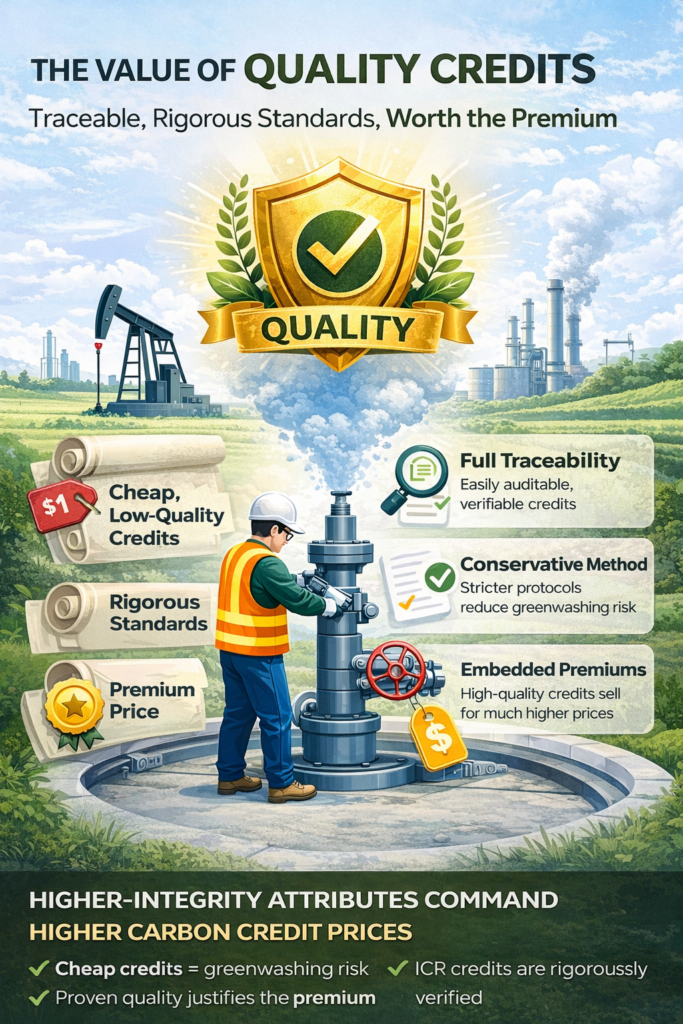
The market data is clear: the cheapest credits available often carry significant greenwashing risk and fail to deliver real, verifiable climate impact. Generic avoidance credits trading at +/- $1 per ton exist for a reason. Buyers with rigorous standards have moved away from them.

Our credits reside on the opposite end of the spectrum, where only high-integrity credits with full traceability will satisfy auditors. Quality credits ensure climate claims are defensible and audit-ready.


Oversupply exists in low-quality offsets — scarcity exists in verified methane abatement with annual issuance and therefore price premiums.

Why the “conservative method” (of ICR-based credits) should be worth more
  • If ACR credits ≈ 2× ICR credits (common outcome because 20y vs 10y), then ICR needs ≈ 2× the $/ton price to produce the same nominal revenue (even before considering the time value of money).
  • If ICR credits are also issued annually (not upfront), NPV discount should be applied; the break‑even ICR price to match ACR’s upfront value becomes even higher (depending on your discount rate).

The “premium for integrity” concept is directionally consistent with broader market evidence that quality/integrity attributes can command meaningful price premiums:
  • Ecosystem Marketplace reports the VCM is shifting toward greater focus on quality and integrity.
  • ICVCM says the CCP label is meant to help buyers identify and price high‑integrity credits.
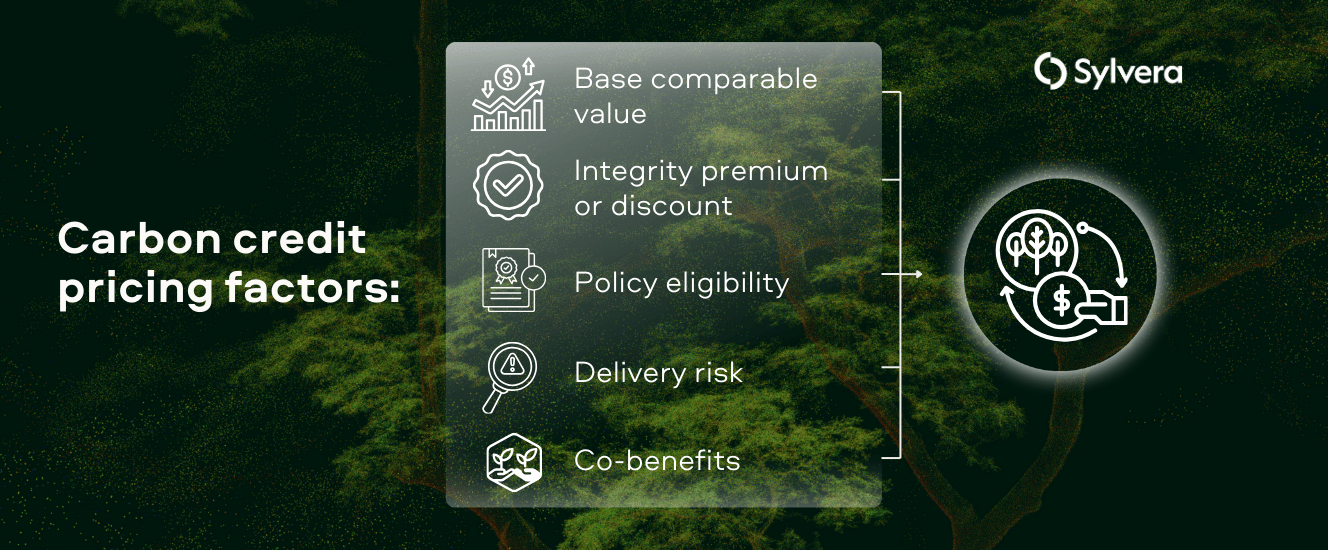
  • Sylvera provides a concrete example of quality premiums embedded in pricing (e.g., higher‑rated projects trading materially higher than lower‑rated equivalents).

Value of our Credits

High-integrity, quality methane credits are gaining in popularity and price due to the impact of eliminating super pollutant methane.  Carbon credit pricing increases the more benefits the credits provide.  Furthermore, pricing premiums are acceptable and justified for a number of additional methodology specific parameters including:

Our credits are issued following our ICR approved methodology while other methane abatement credits follow the ACR approved methodology. As you analyze the differences between the two methodologies, major differences arise that support pricing premiums for the ICR-based credits.

Comparing Methodologies

ICR Methodology (supporting pricing premium):

  • ICR requires stricter/longer MRV: more post-plug assurance steps (annual inspections + Qpost thresholds + issuance pausing). Credits are issued annually and only if MRV inspections guarantee no leakage which ensures high-quality and permanent credits that carry a price premium as a result. Annual physical inspections for the first 3 years post-P&A, with stability only after two consecutive inspections that show no methane / no disturbance / no venting. ICR’s Qpost section explicitly ties monitoring results to pausing issuance and potential well-level disqualification if leakage persists.
  • ICR’s MRV-to-issuance linkage is explicitly annual, with no “issue all upfront” language shown. Credits are issued annually after yearly MVR.
  • ICR only allows 10 years of credits to be issued. The same amount of methane is abated but ICR takes a much more conservative approach by only allowing 10 years of credits for the same abatement versus 20 years with ACR.  With all else being equal, this alone supports a pricing premium of 2x the price of methane credits via the ACR methodology.

ACR’s Methodology (lack of pricing premium support):

  • ACR’s initial MRV burden is lighter and more “event-based,” and allows 20 years of credits to be issued in the plugging year providing an unfair economic advantage to projects following the ACR method.
  • ACR has no annual MRV requirement for 20 years which could result in unknown leakage and potential credit cancellations.
  • 20 years of credits allowed versus 10 years for ICR-based credits. So for the same amount of methane abated, there are twice as many credits created with ACR’s methodology compared to ICR’s more conservative and higher-integrity credits.

Interpretation and affect on credit pricing

  • Credit volume: Often reasonable to expect ACR ≈ 2× ICR for the same measured methane rate, primarily due to issuance for 20 years vs 10 years.
  • Price required to equalize value: if ACR has ~2× tons, then ICR needs ~2× $/ton to match gross value; when incorporating annual issuance by ICR, NPV and extra MRV costs can push the needed premium even higher for ICR-based credits.


Current JB Wells Methane Carbon Offsets (credits) are valued at:  $42/credit
Impact of Our Projects

Our projects create economic benefits, environmental, health and safety improvements, and improve air and water quality for local communities. They qualify under Article 6 of the Paris Agreement and meet 5 of the United Nation’s Sustainable Development Goals (SDGs).

SDG Compliance

Our projects are located in the United States, and supports the country’s overarching sustainable development priorities, including:

  • Methane emissions reduction aligned with the U.S. Methane Emissions Reduction Action Plan and the Global Methane Pledge
  • Land reclamation and water protection under the U.S. EPA’s Clean Water Act
  • Job creation in rural areas, supporting economic development and workforce transition goals from fossil fuels.

Detailed Explanation of SDG Contributions:

SDG 3: Good Health and Well-being

Methane and VOC emissions are harmful to human health, causing respiratory and neurological issues. The project reduces exposure by eliminating fugitive emissions through permanent well abandonment.

Monitoring and Reporting:

  • Pre- and post-abandonment air quality data is collected.
  • Community health assessments are documented to evaluate improvements.

SDG 6: Clean Water and Sanitation

Sealing wells prevents contaminants like hydrocarbons and brine from leaking into groundwater, safeguarding water resources for surrounding communities.

Monitoring and Reporting:

  • Groundwater quality testing is conducted before and after well abandonment.
  • Reports on contamination levels are included in monitoring submissions.

SDG 8: Decent Work and Economic Growth

The project generates local employment opportunities during well abandonment, reclamation, and monitoring activities, benefiting rural communities economically.

Monitoring and Reporting:

  • Employment records and workforce training logs are maintained.

  • Economic impact assessments are included in annual project reports.

SDG 13: Climate Action

By eliminating fugitive methane emissions, the project achieves significant GHG reductions, contributing to global climate change mitigation.

Monitoring and Reporting:

  • Methane reductions are continuously monitored using SOOFIE® sensors.

  • Data is validated by third-party auditors and reported to stakeholders.

SDG 15: Life on Land

The project restores land previously occupied by oil and gas infrastructure, enabling agricultural use or natural habitat regeneration.

Monitoring and Reporting

  • Post-abandonment land use assessments are conducted.

Alignment with National Sustainable Development Priorities

Our projects support the United States’ nationally stated priorities related to environmental protection, climate change mitigation, and rural economic development by:


  • Reducing methane emissions, aligning with federal GHG reduction targets.
  • Restoring land to productive uses, supporting agricultural and ecological priorities.
  • Enhancing rural livelihoods through job creation and local economic activities.


Reference our project specific PPDMRs for more information and tracking.

Plug the Past.

Restore the Land.

Own the Impact.

Let’s Connect!

Start a conversation

JB Wells is positioned to define the standard for methane abatement credit quality in the United States market.

If you’re evaluating methane abatement opportunities, carbon credit procurement, or capital deployment into climate infrastructure, we’re happy to share more about our execution model, verification framework, project pipeline and investment opportunities.

Use the form to reach our team and we’ll follow up directly.